
Summary
Aging is multifactorial. It is several diverse and distinct molecular subproblems. Very effective treatment of aging will clearly require the intelligent combination of several elements (several separate therapeutic interventions). Many big, worthy problems humanity has accomplished were also multifactorial and required the combination of several separate solution elements (solutions to separate subproblems).
Lifespan and healthspan extension are the ultimate result of very effective comprehensive treatment of adult biological aging pathology. They are the obvious outcome metrics for any final or somewhat comprehensive solution to aging. However, that does not make them, or their surrogates, the right metrics for testing individual interventions or for tracking progress of the field.
In particular, this document makes 2 claims:
Lifespan, healthspan, or their surrogates are not the appropriate way to test whether individual interventions will eventually play an important role in an overall suite of aging/longevity interventions.
Lifespan, healthspan, or their surrogates are not the appropriate way to track progress of the field on the way to comprehensive, very-effective treatment for aging pathology.
Some implications of these claims are:
The field should be less focused on lifespan studies of single interventions. Such studies should get less funding and less attention/press/sharing, relative to 4 other quite different things:
science evaluating the efficacy of single interventions against specific subproblems of aging
science finding, evaluating, and documenting the evidence for different subproblems being essential aspects of aging and drivers of multiple chronic diseases of aging (subproblems whose individual treatments themselves embody the geroscience hypothesis)
science finding biomarkers/diagnostics quantifying subproblems of aging (as opposed to global surrogates for aging/lifespan/healthspan as a whole, aka estimates of “biological age” as a whole)
tests of combinations of many interventions using lifespan, healthspan, or surrogates as endpoints
The NIH’s ITP program’s results are not the right way to track progress of the field.
(In a specific special case of the first bullet point above:) People should stop lamenting that no single intervention has yet beaten a decades-old severe calorie-restriction lifespan result in mice. This does not mean that there has been no progress in the field over those decades.
These claims and their implications may seem controversial, even heretical. Clearly the field has not embraced and internalized them widely since many people still make the assertions that there’s been no progress since the old CR result, the ITP is regularly held up as the gold standard, and lifespan studies of single interventions still get a lot of funding, mindshare, and viral propagation. And yet almost everyone agrees that aging is multifactorial and few people seriously disagree with the idea that many different interventions will eventually be necessary1, so it is strange that the claims & implications above that follow fairly directly & straightforwardly from these simple facts could seem so heretical. There’s a cognitive dissonance in many people in the field who agree with the multifactorial aspect of aging and accept that multiple interventions are inevitably needed in humans but still make the kinds of claims described above and/or fund, reshare, or discuss the kinds of studies that don’t make sense in that context. History and inertia are perhaps to blame, as discussed below.
The sections below will also expand on and defend the above claims by considering 3 categories of analogies that share with aging these simple properties of being multifactorial in the sense of having multiple subproblems and eventually requiring multiple separable elements of an overall solution: (a) a simple illustrative example, (b) two common & familiar-to-most-people fields, and (c) several previous big multifactorial problems/projects successfully solved by humanity. The first two of these are discussed in the next section, followed by a section showing an alternative path forward for the aging/longevity field instead of primarily using single-intervention lifespan/healthspan studies. Lastly, the analogies to other big past projects of humanity will be covered.
Individual intervention tests: analogies
Aging & biology are complex. To illustrate the essence of the claim about how to evaluate individual interventions, consider a simpler imaginary system in which their are only 2 subproblems that limit functional lifespan. Pretend that a boat must ferry cargo across a body of water but suffers from 2 main problems:
Its hull is old and develops small holes regularly due to direct exposure to the corrosive water, and if uncorrected these holes slowly expand.
It must travel over some kelp some of which extends from the bottom close enough to the surface to become tangled in the boats propeller or rudder.

Now consider 3 interventions: A. Repair/patch the holes in the hull periodically. B. Remove the kelp strands from the propeller periodically. C. Replace the containers that the cargo is carried in with lighter-weight containers such that the boat rides higher in the water, causing both less of the hull to be exposed directly to the water causing fewer holes to develop and causing the propeller & rudder to ride higher where it encounters fewer kelp strands causing fewer to become tangled. Imagine the following: Studies of the effect of intervention C alone show that it extends the useful life of the boat vs. no intervention. Studies of the effect of intervention A alone and separate studies of intervention B alone show that neither alone increases the useful life of the boat vs. no therapy at all. Should we conclude that interventions A and B have no value?
No, of course not. The monotherapy studies of A or B alone each left the unaddressed subproblem to eventually worsen to the point of ending the boat’s useful life. Imagine that studies of using both interventions A and B together would show useful life of the boat increased massively (e.g., 10x+), but the impact of C alone was only +10%. Further imagine that adding C to the combination of A+B increased useful life by only +10% compared to A+B without C. Were only individual interventions to be studied, and were only the endpoint that we ultimate care most about (useful life of the boat in this case) to be the only endpoint considered in each monotherapy study, it would have looked like C was the best intervention, but ultimately both A and B were the key interventions with C providing only marginal relative value.
This is a toy hypothetical. Many aspects make it an unreasonable analogy for aging, such as the fact that the interventions are relatively simple and it is relatively easy to know when each is needed. Nonetheless, it shares with aging the basic characteristic of having separable subproblems and one category of interventions that can mitigate most/all of them but other interventions that can more effectively mitigate fewer or only 1 subproblem, leaving others unalleviated. Perhaps there are other similarly simple analogies that demonstrate the same point but this was the simplest one I could come up with quickly. I’m surprised the field doesn’t already have a standard analogy used for this.
Next, consider instead 2 real-world analogies with more complicated systems: auto repair & dentistry. Imagine you saw the following paper (which is not real and was generated with AI for illustrative purposes only):
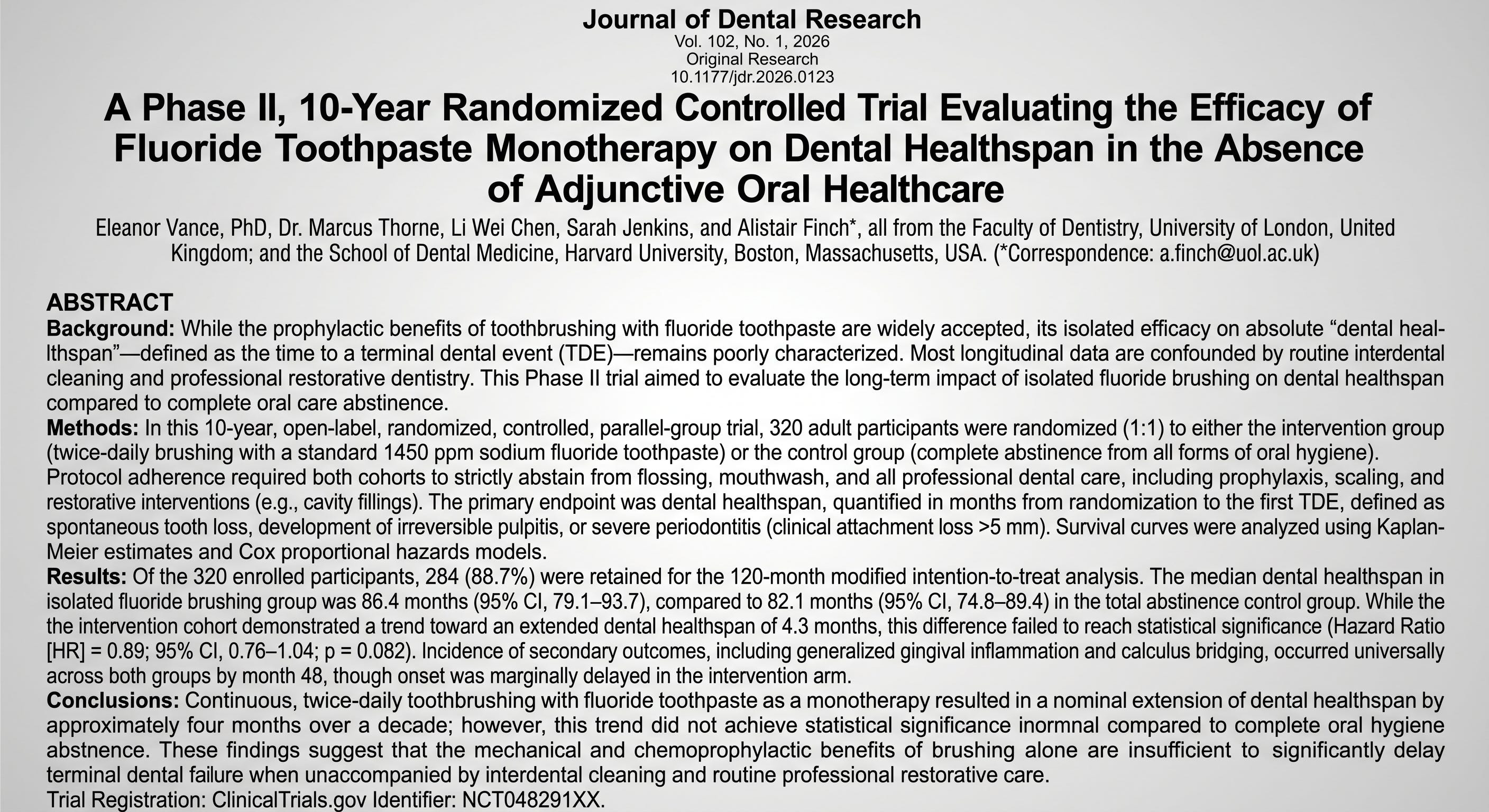
In summary, the reported study evaluated the effectiveness for long-term dental health of just toothbrushing with no other dental health practices/interventions (no flossing, no limiting of sugary foods & drinks and gum, no visits to the dentist for cleaning, cavity filling, root canals, etc.). What would your estimation be of the value of this paper? Would you conclude that tooth brushing is unlikely to be an important intervention in oral healthcare? Of course not.
Like aging, both automotive care and dentistry involve complicated systems (though less complicated than the aging of the whole human body) with many different subproblems. In both these areas and aging, it’s commonly accepted that multiple interventions are required for long healthy functional lifespans of the relevant systems, which is mostly like aging though in the aging field the need for multiple interventions is not as salient or openly accepted and directly addressed in all discussions/contexts (even if most will acknowledge it if forced to confront the question). Distinctly unlike in the aging field, in both automotive care and dentistry no one thinks that evaluating how long a single intervention by itself keeps the system healthy has any useful meaning. Why not? Or why do so many in the aging field?
No one considers what if I only ever do oil changes on this car but never do any of the other regular maintenance, never change the tires, never repair anything if the check engine light comes on, never clean the fuel injectors, never clean any rust off, etc. How long will the car run with only oil changes before breaking down? No one ever tries that with 100 cars and compares vs. another 100 where they do nothing. Or 100 where they clean off the rust but don't do the oil changes nor any other intervention. Etc. The results of such hypothetical studies of the automotive lifespan would be considered meaningless by most people.
Similarly for studies of flossing without brushing nor dentist visits, or cavity filling without flossing or brushing or root canals, etc.
Why does it make sense for lifespan/longevity but not in these other systems? It doesn’t.
Minor quibbles
Some might object that auto care is a poor analogy for the aging field since living organisms have in-built repair & regeneration abilities and/or because the subproblems cars suffer don’t interact as aging’s subproblems do, but these are minor quibbles that don’t spoil the things that do map well.
Yes, in biology organisms have built in repair or regeneration that can handle a certain rate of damage accumulation or tissue loss, but in all such areas the damage accumulation rate or tissue loss rate rises with aging and the repair or regeneration processes decline with aging, such that in the areas where there is repair/regeneration the age-related functional decline is just slightly delayed. In the long-term, the built-in repair doesn’t make aging fundamentally different in kind. Different subproblems still eventually cause functional decline via different molecular problems.
Also, it’s true that crosstalk between subproblems in biology and specifically aging is real and doesn’t occur meaningfully in the car analogy, but this is minor. None of the subproblems in aging affect the others enough that fixing one means you don’t have to fix any of the others. Each subproblem simply exacerbates the others as it itself worsens by speeding the other pathologies (or inhibiting the other areas inbuilt repair/regeneration mechanisms). One could adapt the toy ship example to incorporate interaction and it wouldn’t change the basic lesson. (I.e.: Removing kelp from the propeller/rudder speeds the boat across the water so that it spends less time in contact with the corrosive water, slowing the rate at which the hull holes develop/grow, and repairing the holes causes the boat to ride higher in the water farther out of reach of some of the kelp reducing the rate at which the kelp becomes tangled. Imagine that each intervention therefore extends the functional life by +5%. This still fails to hint at the real value of each intervention within the context of a combination that includes them both.) The part of the analogy between auto care and aging that does work is the important part: that in the long run all the subproblems have to be fixed for maintaining full function long-term.
Paths forward for the field
Multiple things go wrong in aging. Multiple interventions will eventually be required to do the best job possible at mitigating all these problems to the best extent possible. All that matters is: what is the best overall combination of interventions (for each person at each time). How important each intervention is depends almost entirely on how well it helps the ultimate endpoint of interest within the overall suite of interventions and hardly at all on how well it works with respect to the ultimate endpoint when used by itself, a way in which no one will use it in the long run (when multiple good interventions are available).
Interventions are still easiest to develop and initially test individually. How should we judge such tests? We should judge them based on their effects on the individual subproblems. If we know the subproblem is pathological, then mitigating it should be good enough.
The problem in aging is that many don’t consider it known definitively that each identified aging subproblem is clearly pathological, so mitigating a subproblem by itself isn’t consider proof of relevance to aging. Some people want lifespan extension from monotherapy use to demonstrate that relevance. This is misguided for the reasons explained above. Lifespan (or healthspan) extension may demonstrate basic relevance, but failure to extend lifespan when used individually does not show lack of relevance (as interventions A & B in the toy ship example above showed), and neither does monotherapy lifespan extension success necessarily show eventual big importance (as intervention C in the toy ship example showed).
Demonstration of the malleability of lifespan was essential in the early decades of the field in order to convince the world that aging itself could be modified and treated. Unfortunately the field has gotten a bit stuck in the rut of thinking that an essential early step in evaluating any potential therapy for aging is to test whether it (by itself) extends lifespan. This practice has been a net negative for the field, obscuring what really matters.
In aging, most if not all identified subproblems (Hallmarks, SENS damage types, Pillars) have been linked to multiple age-related chronic unwanted medical conditions. Thus, treatments for any of the subproblems should embody the geroscience hypothesis and mitigate multiple diverse age-related diseases (even if they don’t affect aging’s other subproblems). Clinical trials against such diseases are good enough to get such interventions FDA approved and make them commercially viable, which realistically is an eventual necessity before they can be combined clinically.
Thus, one path forward for the field is to pursue such commercialization via clinical trials & regulatory approval. The steps are approximately:
Initial mechanistic understanding of addressing one or more known aging subproblems, followed by
data showing that they do successfully address these subproblem(s) in vivo, then
commercialized via clinical trials demonstrating successful treatment for an individual age-related chronic indication, finally followed ideally by
either label expansion to show effectiveness against other age-related indications or widespread off-label prescription for such other aging indications with apparent good results.
This is already happening in funnel fashion with many things in parallel at step 1 & 2, a few getting to step 3, and not much yet happening at step 4, but the clear potential for some in the not-too-distant future.
Aging is multifactorial, so progress of the overall field in solving aging using this approach must therefore be tracked multidimensionally: by tracking
which aging subproblems have good interventions,
how effective the best interventions for each subproblem are for that subproblem, and
where each is in its regulatory & commercial deployment, along with of course
science quantifying the strength of the evidence that each identified aging subproblem is in fact a core aspect of aging that underlies the causal pathology contributing to multiple age-related diseases
The problem with using lifespan, healthspan or surrogates as endpoints in single-intervention studies is that those endpoints don’t tell us how well any subproblems are solved. They effectively treat the organism as a black box. We need data elucidating the underlying biology relevant to the main addressed subproblem(s) of aging to judge an intervention’s long-term importance.
Combinations
Another path forward for the field is to test combinations of interventions, necessarily for now in model species, but eventually in humans. Such combination studies can provide insight into which interventions or categories of interventions have additive effects (in general or specifically with which others) vs. non-additive effects, or even antagonistic effects. Unfortunately, such combination studies suffer from 3 big difficulties:
Academic science does not reward integrating multiple breakthroughs from others as much as new breakthroughs.
Biotech companies are not financially rewarded for results that combine Intellectual Property (IP) from multiple other parties as much as new techniques protected by new IP.
The space of combinations is combinatorially large, and exploring that space remotely comprehensively or even systematically is extremely expensive in time and resources.
As a result, few projects in the field have explored combinations much. There was some work in this area in C.elegans circa 2016 (Lithgow lab at the Buck Institute; I have not followed nor heard much about any later combination work in C.elegans). There is only one group doing much with combinations in mice (Longevity Escape Velocity Foundation). Funding for combination studies in mice is hard to raise.
Combination studies are more justified in using the endpoints/metrics of ultimate interest: lifespan, healthspan, or their surrogates. Such endpoints can help determine what interventions have additive vs. non-additive (vs. antagonistic) effects.
Some people think may think that progress of the field can be tracked by the performance on these overall metrics of combinations as the field progresses. That may be possible in the future but does not seem to be the case yet. Right now, the main goal of LEVF is simply to demonstrate much greater overall efficacy via combinations than many people think is possible, to help catalyze public awareness and overall funding for the field. Another potential benefit of combination studies using lifespan as endpoint is to test whether certain categories of interventions are more likely to be additive in effect vs. other categories (with one common hypothesis being that damage repair interventions are more likely to be additive while metabolism slowing interventions are more likely not to be). Those goals are easier lifts than serving as a metric for overall field progress, which may not be possible with lifespan alone even using combination studies. Often with very complex overall problems that have several (themselves-complicated) subproblems, the metrics of overall ultimate success are terrible metrics for tracking overall progress, as we will discuss below.
Final metric inappropriate for progress
Lifespan or healthspan are also not the best way to track progress of the field, at least at this stage in the history of the field when we are still far from having fairly comprehensive solutions to all the subproblems. In general, for complex projects with multiple separable subproblems, the metric most appropriate for measuring ultimate success is often (if not usually) the wrong metric for tracking incremental progress towards the final comprehensive solution. Multidimensional progress tracking of progress towards solutions for each subproblem is needed. Substantially solving the problem of adult biological aging should thus not be viewed as an outlier with respect to this property of the ultimate endpoint metric not being the right intermediate metric.
I’m not a historian of science & technology, so the following examples are just a quick attempt to broaden what is obvious and intuitively true for the Apollo program, an example I’ve used before, to include a broader list of humanity’s big project accomplishments, especially including some that have substantial scientific (not just engineering) components. The following info was put together with the help of AI and I did not double-check every detail with primary sources. But I also didn’t rely on only one AI LLM model. ChatGPT 5.5, Claude Sonnet 5, Gemini 3.1, Perplexity’s Sonar Reasoning Pro, and Grok 4.3 were all consulted and the results here are the consensus amongst all these modeled filtered through my own spot checks & subproblem enumeration filtering.
Consider 8 prior big problems of humanity, all of which were accomplished despite seeming daunting many decades before achievement, all of which involved multiple nontrivial subproblems (some if which may seem easy in retrospect but were nonetheless big problems when initially faced), and all of which took many years and hundreds to hundreds of thousands of people:
the first transatlantic telegraph cable
(durable) organ transplantation
the moon landing (Apollo Program)
IVF
smallpox eradication
HIV/AIDS treatment
sequencing the human genome (Human Genome Project)
creation of mRNA vaccines
Each of these problems had an obvious primary overall metrics of success, just as the aging field has lifespan, and in each of the above cases, progress towards the eventual complete solution was not well tracked by progress measured using the obvious primary outcome metric(s). For example, farthest distance from earth of a crewed mission was a terrible metric to track Apollo Program progress. % of human DNA sequenced was a terrible metric to track progress of the Human Genome Project. Length of post-transplant survival was a terrible metric to track progress towards successful durable organ transplantation. Whether or not any babies were born via IVF or a count of those that were was a terrible metric to track progress towards successful IVF techniques. Etc. In all cases such metrics if graphed would show hockey-stick style sudden progress right at the end.
The following table summarizes for each of these problems/projects and for aging, the year of accomplishment, the obvious primary outcome metric, and a (not-necessarily-exhaustive) list of separable subproblems.
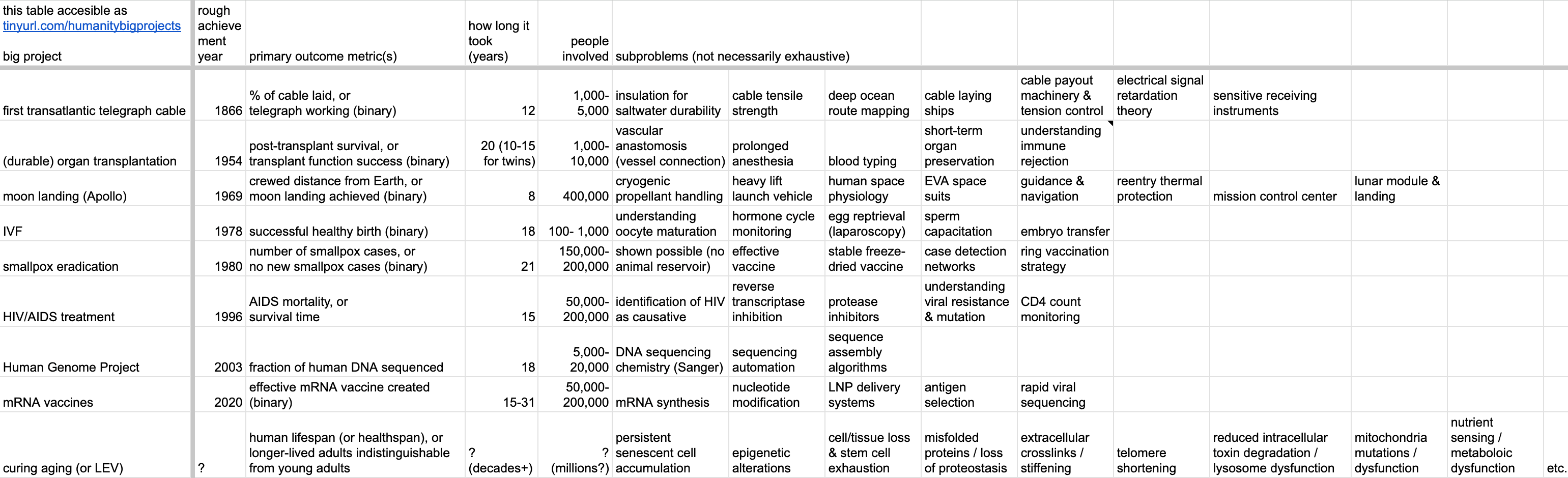
This table can be viewed larger, as a spreadsheet, at tinyurl.com/humanitybigprojects.
In most cases, it should be fairly obvious why the primary outcome metric was not a great measure of progress. The question then is, why should lifespan, the obvious primary outcome metric for the problem of aging, buck the trend and be a good progress metric for that problem?
Maybe it will turn out to be a good metric in the future when more progress has been made, but there’s no reason it necessarily has to be so. There’s no evidence that it is a good metric for the overall aging field’s progress yet, and early indications suggest that it isn’t. For example, the fact that the longest lived mice have not been living progressively longer so far, rather than being signs of stagnation in the field are in fact a good demonstration of this principal that lifespan is a terrible metric of incremental progress in the field, at least for these early decades.
This rests on the fact that the field has made great progress over the past few decades:
Many subproblems of aging have been identified with reproducible science linking them to aging and to multiple age-related chronic diseases (SENS, Hallmarks, Pillars), with most of the formalization within the last 20-25 years.
Enough science has progressed to translational potential that an entire subsector of biotech has arisen with 300+ companies, with the biggest growth in new companies having come in the past 10 years. A large fraction of these are pursuing novel therapies on a pharmaceutical regulatory path towards human clinical trials.
The translated science has demonstrated preclinical efficacy sufficient for 60+ companies to have raised $3million each and for more than a dozen companies to have successfully demonstrated human efficacy in phase 2 trials against targets meaningfully related to core subproblems of aging, mostly within the past 5-10 years.
This is hardly meaningless progress, but it is not at all represented in any overall lifespan achieved vs. time data.
Aging may be a bigger problem than all of these prior big problem examples, but note that many of these prior big problems probably seemed insurmountably big to most people at the time 20-50+ years before they were solved.
Conclusion
It’s possible humanity will one day fully solve the problem of (adult biological) aging. It’s possible that overall lifespan may not move dramatically for a long time on the way to a full solution but may suddenly start moving a lot only very close to the achievement of the goal.
Either way, lifespan should be less of a focus of the field at this stage of overall progress, while the field is dominated by studies of single interventions in isolation. These do not tell us the important things that we need to know to eventually make substantial progress. Real progress lies in detangling the black box of the living organism: understanding how each intervention affects the subproblems of aging and how we can quantify these subproblems, their effects on age-related diseases, on mortality, and on each other. This is what we need in order to know how to combine interventions and who needs which combinations.
The two notable exceptions to the widespread agreement that aging will require multiple interventions are:
(A) The small minority of the field who advocate brain transplants into young replacement bodies is the best way forward, ideally eventually combined with gradual progressive piecemeal brain replacement while preserving self. This group should agree with the premise of this document that lifespan studies of other single interventions are not very useful. And since the basic head/brain transplant idea subdivides into at least 2 non-trivial subproblems (growing the replacement body ethically and doing the head/brain transplant surgery successfully), this group probably should also agree with the 2nd part of this document in that lifespan achieved is not a good measure of incremental progress.
(B) The 2nd group that may disagree about many interventions being required is the different small minority in the field who believed aging is programmed: that it has (probably evolutionarily derived) central drivers which if found & manipulated could fix all aspects of aging. Some programmed aging advocates may believe that just a single central driver causes all of aging. Here again, most in this camp should agree with the 2nd main claim of this document, that progress of the overall field measured using lifespan will be hockey-stick-like nonlinear since it will be hardly any progress for a long time until the driver(s) is/are found, then sudden great progress. A better measure of progress of this strategy is some kind of metric of what fraction of the places the driver(s) could be have been checked. It’s like a needle-in-a-haystack search problem, and tracking progress in such a problem by the fraction of the haystack searched well is a better measure of incremental progress than whether the needle has been found. With respect to the 1st main claim of this document, programmed aging advocates should also largely agree with this document that lifespan results for a single intervention that does not manipulate the central programmed driver(s) are not interesting. Such single interventions would have much bigger effect sizes than the lifespan results the field has generated so far.
This is basically the argument for why TAME had to invent a composite chronic-disease endpoint instead of touching lifespan directly, the FDA still won’t accept “aging” as an indication, so a multi-morbidity surrogate became the workaround. Your subproblem framing also explains why the newer omics composite clocks (OMICm-Age, multi-organ proteomic panels) are getting more attention than single-number clocks like PhenoAge, they’re explicitly trying to decompose “biological age” back into pathway level subscores instead of collapsing everything into one metric. The risk I’d flag: those subscores are only as good as the causal evidence that the subproblem is upstream of disease rather than just correlated with it, and a lot of the omics panels are still fit to chronological age or mortality as the training target, which quietly smuggles the black box back in.